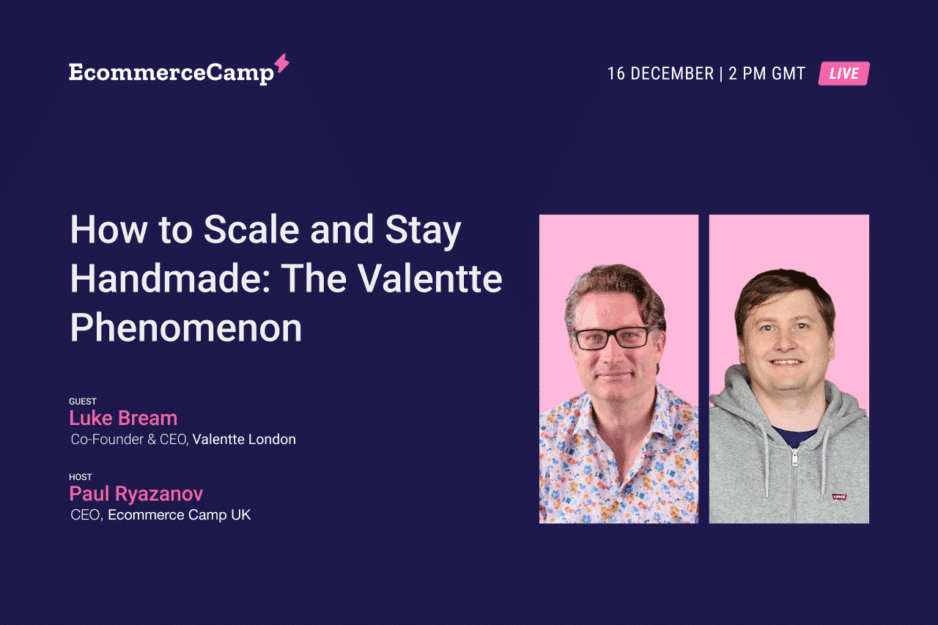
Everyone talks about starting a brand – few talk about surviving the jump from $3–5M to $10M. Luke does.
Table of Contents
Valentte: Company Overview

- Founded: 2011 by Luke & Justina
- Specialty: Natural, handmade home fragrance & skincare products.
- Highlight: Grew from a single market stall to a beloved multi-channel UK brand while keeping every product personal, hand-wrapped, and rooted in true artisan craftsmanship
Today, Valentte is recognised for its commitment to natural ingredients, small-batch production, and creating products that genuinely support wellbeing.
Speakers



Watch the Video
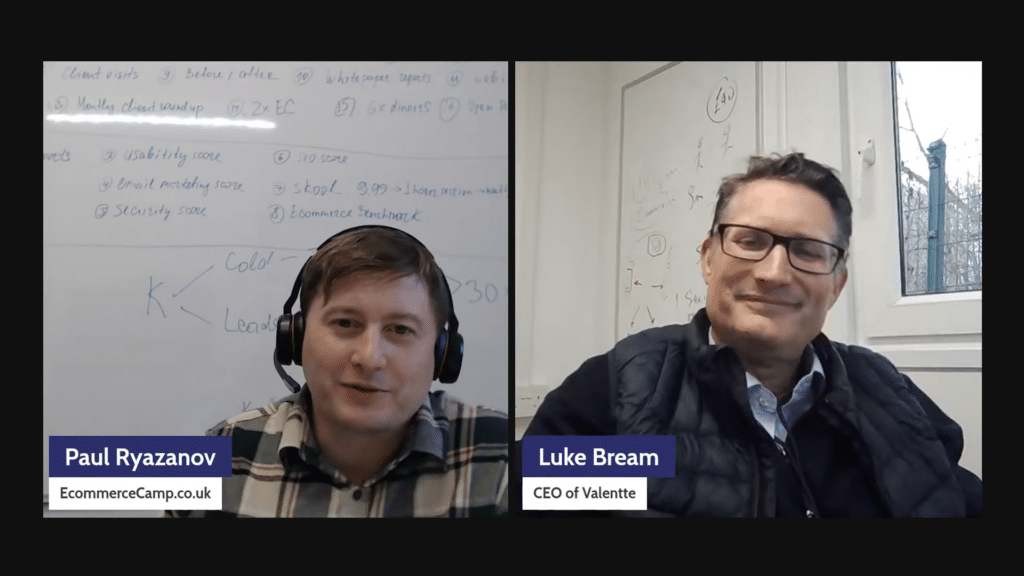
Prefer to watch? View the full session video here.
Read the Session Overview
Get a concise summary of the session’s key points and insights.
The Handmade Paradox: How Valentte Scaled Without Losing Its Soul
Valentte didn’t start as a growth experiment, a performance-marketing play, or a pitch-deck story.
It started with hands – quite literally.
Before ads, before scale, before systems, Valentte was a small British brand making fragranced products by hand. The appeal wasn’t efficiency or margin optimisation. It was care, craft, and the feeling that someone had genuinely taken time to make something beautiful.
For years, that choice came with a cost.
Before COVID, Valentte was still a tiny business:
- Around five people
- Roughly £500,000 in annual revenue
- No aggressive growth ambitions
- No real sense that it would ever become “big.”
Then everything changed.
Not because Valentte abandoned its values – but because it finally learned how to pair craftsmanship with modern distribution.
This is the story of how a handmade brand scaled dramatically without outsourcing production, automating the soul out of it, or turning into a commodity DTC business.
Section 1 – Quick Takeaways
- Valentte began as a craft-led business, not a growth-first one.
- For years, it stayed intentionally small and hands-on.
- Scale arrived when distribution caught up with product quality, not the other way around.
Pre-Scale Reality: Why Handmade Brands Often Stay Small
For a long time, Valentte looked like many artisanal brands:
- High-quality, lovingly made products
- Strong word-of-mouth
- Loyal customers
- But limited reach and constrained growth
The core tension was obvious:
If you make everything yourself, growth usually means one of three things:
- Compromising quality
- Outsourcing production
- Staying small
Valentte chose the third option – at least initially.
They weren’t chasing hypergrowth. They weren’t building investor decks. They were simply making beautiful products and selling them to people who appreciated them.
- But the brand had a hidden advantage:
- Exceptionally high repeat purchase rates
- Deep trust in quality and consistency
- Strong emotional attachment from customers
- What they lacked wasn’t demand – it was distribution and visibility.
Section 2 – Quick Takeaways
- Many craft brands stall not because demand is weak, but because distribution is underdeveloped.
- Valentte had strong fundamentals long before it had scale.
- Product quality created latent demand that hadn’t yet been unlocked.
COVID: The Accidental Catalyst
COVID didn’t create Valentte’s demand.
It exposed it.
When physical retail and traditional channels disappeared almost overnight, Valentte had no choice but to move decisively online. What followed surprised even the founders.
They began investing seriously in:
- Meta (Facebook and Instagram) advertising
- Google search and shopping ads
- Performance-driven acquisition at a meaningful scale
The numbers escalated quickly:
- From around £1,000 per week in ad spend
- To nearly £1,000,000 over the course of a year
The result wasn’t incremental growth.
It was explosive.
Revenue increased roughly 50x in a relatively short period.
The important detail is why this worked:
- The product was already excellent.
- Customers were already repurchasing at very high rates.
- Advertising didn’t “persuade” people – it simply introduced them.
This wasn’t hype-driven marketing. It was distribution finally aligning with product truth.
Section 3 – Quick Takeaways
- COVID forced Valentte to modernise distribution rapidly.
- Paid media worked because product-market fit already existed.
- Ads amplified reality – they didn’t manufacture demand.
Scaling Without Outsourcing: The Hard Choice
Many brands scale by changing what they are.
Valentte chose to scale by doing more of the same – better organised, better staffed, and more disciplined.
Instead of outsourcing production overseas or automating aggressively, they made a harder call:
- Keep production in-house
- Keep manufacturing in the UK
- Keep products handmade
- Hire and train more people rather than cutting corners


As demand surged, this decision created immediate pressure:
- Production bottlenecks
- Hiring challenges
- Training requirements
- Quality control complexity
But it also protected the brand’s core promise.
Customers weren’t just buying candles, fragrances, or bath products. They were buying:
- Trust
- Consistency
- A feeling of authenticity
Outsourcing would have scaled revenue faster – but at the risk of breaking the emotional contract with customers.
Valentte chose the slower, more painful path.
Section 4 – Quick Takeaways
- Valentte scaled by adding humans, not removing craft.
- In-house production preserved brand trust.
- Operational difficulty was accepted as the cost of authenticity.
From Five People to Two Hundred: When Chaos Demands Structure
At small scale, culture and communication are informal.
At 200 people, informality becomes dangerous.
As Valentte grew to roughly 200 employees, the business hit a familiar scaling wall:
- What worked at 10 people broke at 50.
- What worked at 50 collapsed at 150.
Once fluid roles had to become defined. Once intuitive decisions had to become documented. Founders could no longer be involved in everything.
This phase required:
- Clear organisational structure
- Defined responsibilities
- Repeatable processes
- Managers, not just doers
Importantly, this wasn’t about “corporatising” the business.
It was about protecting craft at scale.
Without structure, quality drifts. With the right structure, craftsmanship can survive growth.
Section 5 – Quick Takeaways
- Scaling people requires systems, not heroics.
- Structure isn’t the enemy of craft – chaos is.
- Process is what allows handmade quality to exist at scale.
The Economics of Trust: Why Retention Changed Everything
One of the most important indicators in Valentte’s business was repeat purchase rate.
Roughly 80% of customers came back.
This single metric changed how the company thought about growth.
High retention meant:
- Ads didn’t need to be perfectly efficient on first purchase.
- Lifetime value justified meaningful acquisition spend.
- Quality problems would show up immediately in the data.
Retention became the real north star.
Rather than asking, “How do we acquire faster?”, the better question became:
This shifted focus toward:
- First-order experience
- Packaging and unboxing
- Product consistency
- Post-purchase communication
Growth stopped being purely a marketing problem. It became a product and experience problem.
Section 6 – Quick Takeaways
- High retention unlocked sustainable paid acquisition.
- Product quality did the heavy lifting marketing couldn’t.
- The first product experience mattered more than any funnel tweak.
Handmade at Scale Is an Operations Problem, Not a Marketing One
As Valentte grew, it became clear that marketing wasn’t the limiting factor.
Operations were.
When you promise handmade quality, every weak link shows up:
- Hiring too fast leads to inconsistency
- Training gaps lead to defects
- Rushed production erodes trust


Scaling handmade products is fundamentally about:
- Training systems
- Quality control processes
- Cultural reinforcement of standards
- Slower, more deliberate expansion
This is why many handmade brands fail when they grow – not because demand disappears, but because operations can’t keep up with expectations.
Valentte survived this phase by staying brutally honest about constraints and refusing to promise what it couldn’t deliver.
Section 7 – Quick Takeaways
- Handmade brands break in operations, not marketing.
- Quality control is a growth constraint, not a hygiene factor.
- Saying “no” to growth is sometimes how you survive it.
The Brand Flywheel: Craft, Story, Trust, Repeat
Over time, Valentte’s growth settled into a clear flywheel:
- Genuine craftsmanship creates trust
- Trust drives repeat purchases
- Repeat purchases justify ad spend
- Ads bring new customers into the craft
- The cycle reinforces itself
Nothing in that loop is particularly “clever”.
There are no hacks. No viral gimmicks. No growth tricks.
Just:
- Product quality
- Consistency
- Patience
- Respect for the customer
In a market crowded with fast, cheap, outsourced products, that simplicity became differentiation.
Section 8 – Quick Takeaways
- Valentte’s growth came from a trust flywheel, not tactics.
- Craftsmanship acted as a defensible moat.
- Simplicity beats optimisation.
Operator Summary: What Founders Can Steal from Valentte
Here’s the distilled playbook from Valentte’s journey:
Product & Brand
- Craft is not a marketing angle – it must be real and operationally enforced.
- Don’t scale what you wouldn’t be proud to repeat 10,000 times.
- Protect the first product experience obsessively.
Growth & Distribution
- Paid ads work best when they reveal quality, not disguise mediocrity.
- Retention is the permission slip for aggressive acquisition.
- Distribution should serve the product – not the other way around.
Operations & Scale
- Handmade scale requires process, training, and patience.
- Structure exists to protect quality, not kill creativity.
- Growth will expose every operational weakness – assume that upfront.
Mindset
- You don’t have to choose between craft and scale – but you do have to accept trade-offs.
- The hard path (more people, more training, more control) is often the correct one.
- Long-term brands are built by doing fewer things exceptionally well, repeatedly.
Final Thought
Valentte’s story isn’t about clever marketing or lucky timing.
It’s about a rare decision in modern commerce:
That choice is harder, slower, and operationally painful.
But when it works, it creates something far more durable than growth alone – trust at scale.
Need Specific, Targeted Advice For Your Store?
Whether you’re embarking on your first steps into the world of e-commerce or already running an established business, don’t hesitate to contact us. Our dedicated team is here to provide unwavering support and assistance throughout your entire journey.