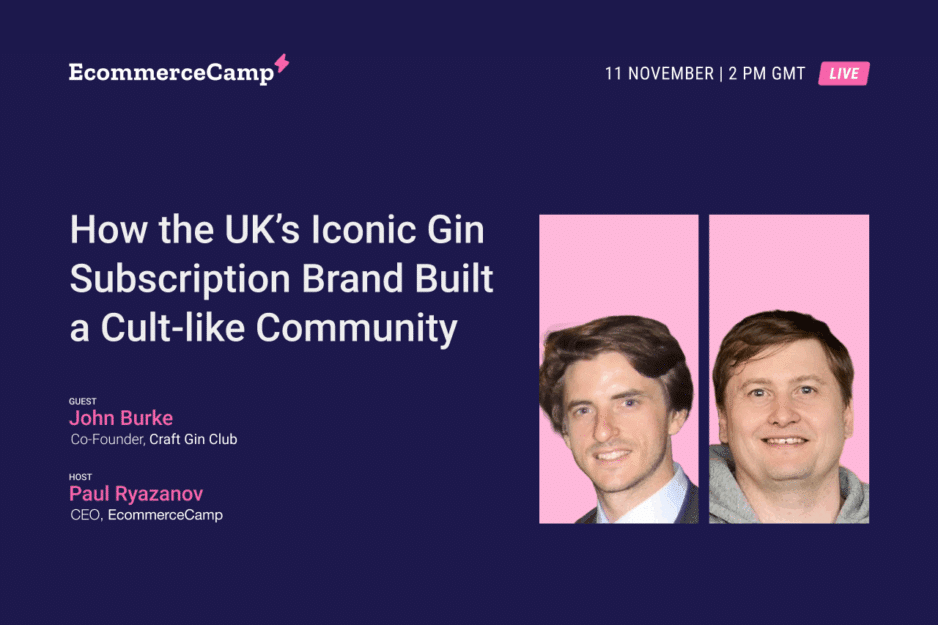
Ever wondered how a simple idea between friends can grow into one of the UK’s most beloved subscription brands?
Join us for an inspiring conversation with John Burke, Co-Founder of Craft Gin Club, the UK’s leading gin subscription brand.
Table of Contents
Craft Gin Club: Company Overview

- Founded: 2015 by Jon Hulme & John Burke
- Specialty: UK’s leading gin subscription service, curating exclusive craft gins, mixers, and treats each month.
- Highlight: Featured on Dragon’s Den and grown into a vibrant community of 200,000+ members, celebrating small-batch distilleries and premium British craftsmanship.
Speakers



Watch the Session
Turn your subscription into a movement. Turn your followers into lifelong fans.
Watch the replay now.

Read the Session Overview
Get a concise summary of the session’s key points and insights.
How Craft Gin Club Built a Subscription Brand That Actually Feels Like a Club
Craft Gin Club didn’t start with venture capital, a polished growth deck, or a clever funnel.
It started in a bar.
Two former business school friends.
A wall of gin bottles.
And a casual observation that would turn into one of the UK’s most successful subscription brands.
Long before “community-led growth” became a buzzword, Craft Gin Club was quietly proving something important:
This is the story of how Craft Gin Club grew from a scrappy idea inspired by a bedroom whiskey club into a business that has shipped to over half a million UK homes — without losing its sense of intimacy.
Section 1 – Quick Takeaways
- Craft Gin Club was born from culture and timing, not spreadsheets.
- The subscription model worked because it was built as a club, not a refill service.
- Content and community came before monetisation.
- Emotional connection consistently outperformed tactical growth hacks.
The Idea: When Timing Does the Heavy Lifting
The original spark wasn’t a market gap analysis.
John was living in Paris when he met his future co-founder in London. Over drinks, he mentioned a friend running a whiskey club out of his bedroom.
The response was immediate:
In 2014, three things collided perfectly:
- The UK gin boom, driven by small, fast-moving micro-distilleries
- The rise of subscription boxes
- A cultural shift toward discovery and craftsmanship
Gin, unlike many spirits, is relatively fast to produce — making it ideal for small distillers experimenting with flavours and limited runs.
Craft Gin Club didn’t invent demand.
They simply organised it.
Section 2 – Quick Takeaways
- Great businesses often emerge from the intersection of trends, not innovation labs.
- Gin’s production flexibility enabled rapid supplier partnerships.
- The product category naturally lent itself to discovery and surprise.
Before Sales Came Content (and a Lot of Facebook Posts)
When the website went live, there was no checkout urgency.
No ads.
No funnels.
No “subscribe now” pressure.
Instead, Craft Gin Club did something most brands rush past:
They built an audience first.
At the time, social media was simpler — and far more generous with organic reach. The strategy was straightforward:
- A Facebook page (pre-Instagram dominance)
- Entertaining, approachable gin content
- A blog to capture email subscribers
- A Mailchimp newsletter
For 6–8 weeks, there were no sales at all.
Only content.
Only conversation.
Only community.
When the subscription offer finally appeared, it was almost casual:
They had a few hundred email subscribers.
That was enough.
Section 3 – Quick Takeaways
- Early growth came from content, not conversion optimisation.
- Email lists mattered more than traffic.
- Selling felt natural because trust already existed.
Pre-Scale Reality: Why Most Subscriptions Fail
Craft Gin Club avoided a trap many brands fall into today.
They didn’t try to be:
- A refill service
- A discount engine
- A convenience play
John put it simply during the talk:
Replaceable products (dishwashing tablets, protein powder, toilet paper) struggle to build an emotional connection.
Curated, niche, fan-driven products thrive on it.
Craft Gin Club didn’t sell “more gin.” They sold:
- Discovery
- Access
- Limited editions
-
Stories behind the bottle
That distinction is everything.
Section 4 – Quick Takeaways
- Subscription fatigue is real — membership fatigue is not.
- Email lists mattered more than traffic.
- Selling felt natural because trust already existed.
Scaling Without Complexity (or Fancy Tech)
Despite being an e-commerce business, Craft Gin Club stayed deliberately tech-light.
For years:
- Google Sheets-powered operations
- Mailchimp handled communication
- Manual processes filled the gaps
Why?
Because complexity distracts from the core job:
Only later did they add tools like Shopify, Recharge, Klaviyo, and cohort analysis platforms — once scale demanded it.
The lesson wasn’t anti-tech.
It was anti-premature optimisation.
Hiring for Resonance, Not Resumes
One of the biggest surprises came from customer data.
Craft Gin Club expected:
- Young, urban gin geeks
Reality looked very different:
- Largely women
- 45+
- Highly loyal
- Highly engaged
So they adapted.
Instead of forcing the brand voice, they hired people who naturally were the audience.
The first hires weren’t engineers or growth marketers.
They were content people.
Because community doesn’t scale itself.
Section 5 – Quick Takeaways
- Data should challenge assumptions, not confirm them.
- Hiring people who are your audience improves resonance instantly.
- Content roles came before operational roles — intentionally.
Dragons’ Den: PR Before Capital
Craft Gin Club didn’t chase Dragons’ Den.
Dragons’ Den came to them.
The reason wasn’t just growth — it was narrative:
- Gin boom
- Subscription boom
- Cultural relevance
The founders saw it for what it was:
The pitch worked. The deal closed. And when the episode aired, they did six months of revenue in ten days.
Still, John is clear:
- Many great companies don’t get investment
- Many deals fall apart after filming
-
The real value was visibility
Where Craft Gin Club Focuses Now
After more than a decade, the acquisition has changed.
Paid channels are harder.
Discount-driven growth is less sticky.
Audiences are more aware — and more selective.
So the focus has shifted back to fundamentals:
- Retention over acquisition
- Brand overhacks
- Relationships overreach
And increasingly:
- Offline experiences
- Real-world events
- Human connection
Because even digital-native brands are still built by people — for people.
Final Takeaways for Ecommerce Founders
- Build the audience before the offer.
- Subscriptions work best when they feel like memberships.
- Content is not a channel — it’s the business.
- Simplicity scales better than complexity.
- Emotional connection is the one growth lever that never stops working.
This LiveTalk was hosted by Ecommerce Camp.
To join future sessions, connect with founders, and access private discussions, join the Ecommerce Camp community.
Need Specific, Targeted Advice For Subscription Business?
Whether you’re embarking on your first steps into the world of e-commerce or already running an established business, don’t hesitate to contact us. Our dedicated team is here to provide unwavering support and assistance throughout your entire journey.